The AI computer nobody has seen
Auren One plays on what tech enthusiasts want right now: to be first, to own the best and to run AI at home, without subscriptions. It is an “AI computer” offered for pre-order since October, through roughly 930 ads on Facebook and Instagram, for a $20 deposit, by a company formed in September. The product’s main image was generated with ChatGPT, and the processor originally advertised is a laptop chip launched in 2021.
Citește investigația în limba română →
The silver cube in the ads
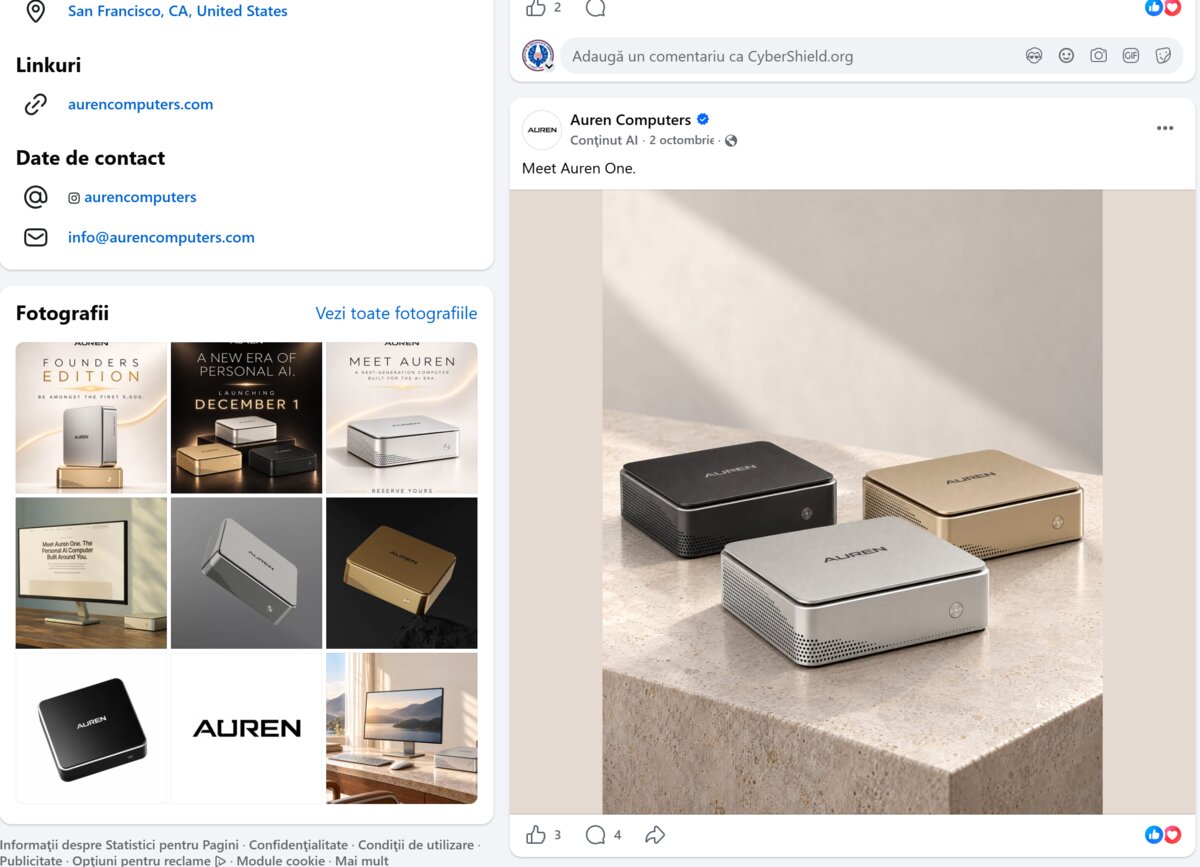
Since October 2026, Facebook and Instagram users across Europe have been seeing the same image: a silver cube on a sunlit desk, bearing the word AUREN. The text promises “$0 per token” and “Private by design”: a computer that runs artificial intelligence at home, with no subscriptions and without data leaving for someone else’s servers. A place in line costs $20 or €20.
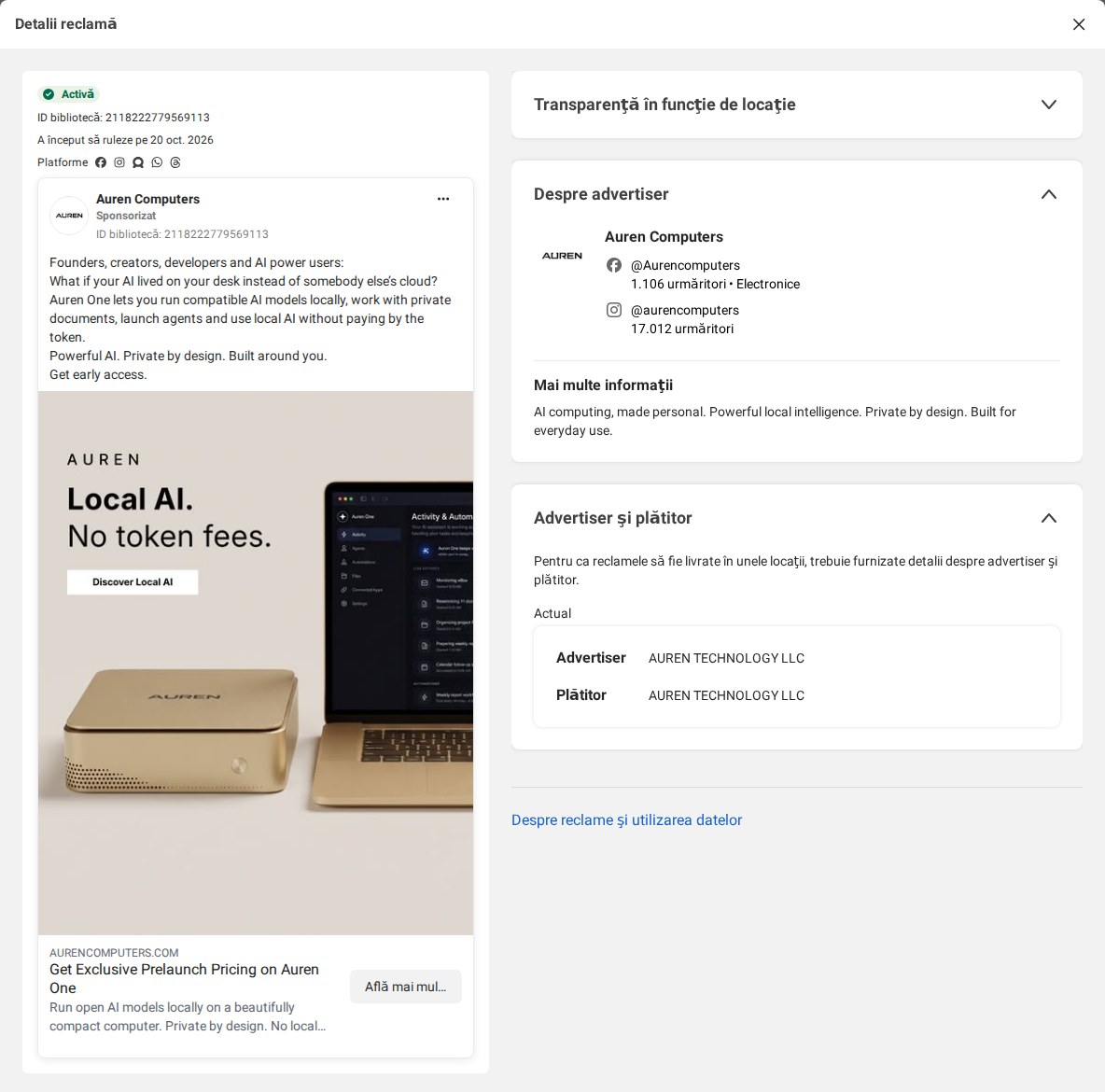
The Meta Ad Library shows roughly 930 ads published by the Auren Computers page, all paid for by AUREN TECHNOLOGY LLC. A single one, running across the European Union since October 20, reached 610,351 accounts. About 34,500 of them are in Romania. In Meta’s breakdown for the ad as a whole, nine in ten accounts reached belong to men.
Artificial intelligence has entered everyday life, and it is here to stay. After nearly four years of monthly subscriptions and pay-per-token pricing, more and more people want to run models at home, on a computer of their own: no monthly bill, and no documents leaving for someone else’s servers.
Tech enthusiasts are the first to buy something like this. They want the latest thing before everyone else (the phenomenon even has a name, FOMO, short for fear of missing out), they want “the best” hardware and they want local AI, without subscriptions. Auren’s ads speak to them directly: “Founders, creators, developers and AI power users.”
And the amount requested is small. For $20, nobody bothers to check who the company is, what the archives show or what the site’s code contains. The investigation below runs exactly the checks buyers skip: it compares the product images with their digital signatures, opens the oldest archived version of the site, reads the code the site sends to every visitor and looks for the company behind the ads. Every finding has its source, and the pages were saved to the public Wayback Machine archive so anyone can verify them.
$20 for a place in line
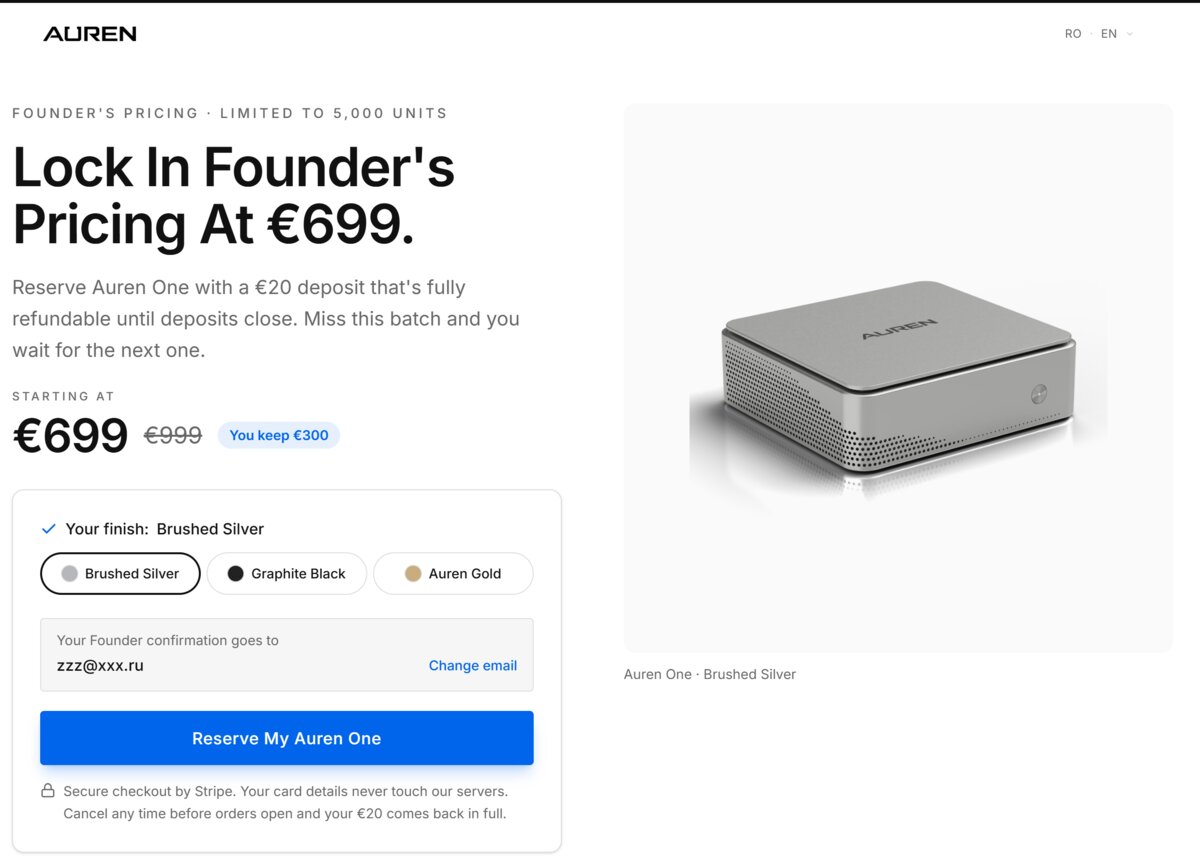
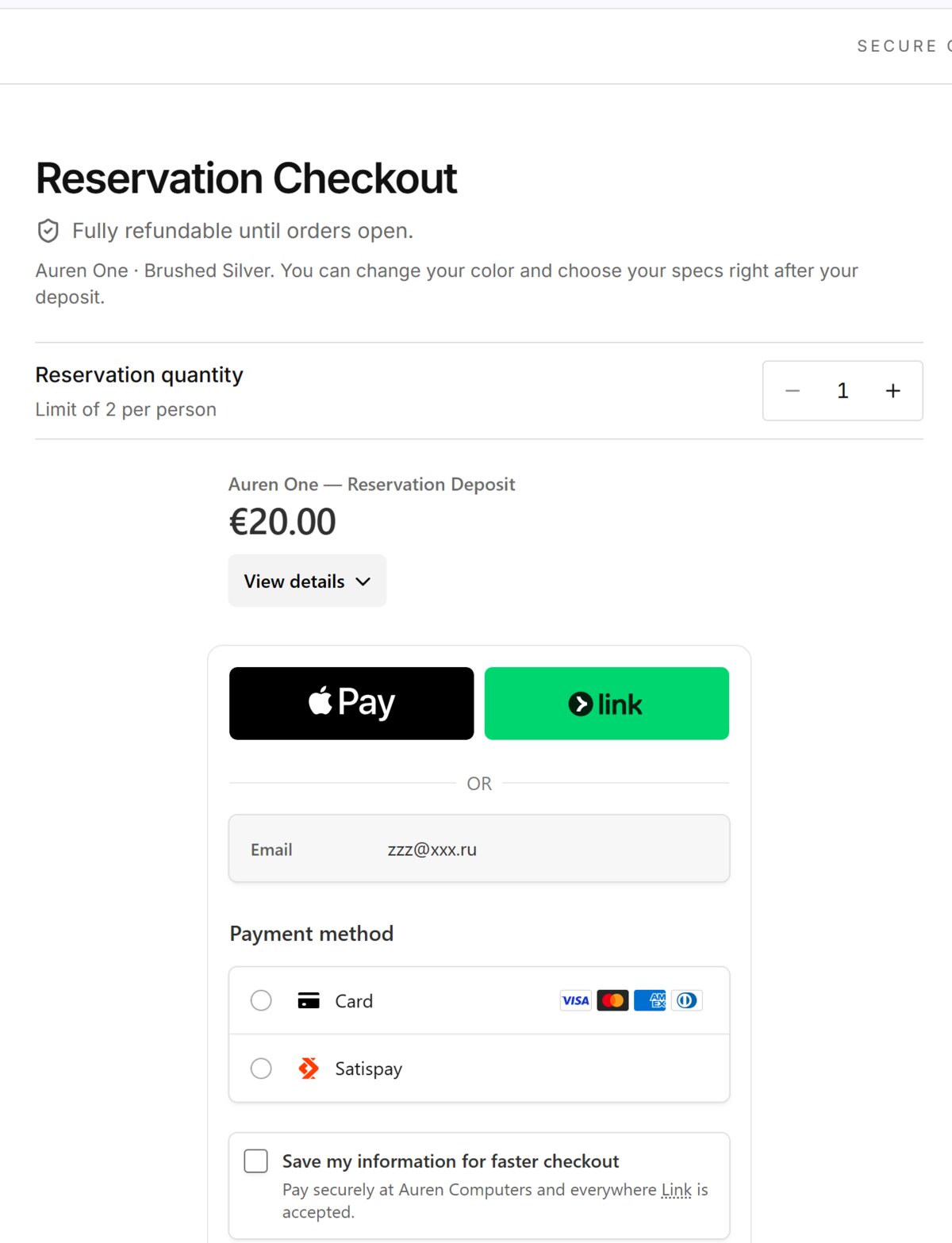
The site aurencomputers.com sells a mini PC called Auren One in three versions: Lite (16 GB of RAM), One (32 GB) and Pro (64 GB). The “Founder’s Pricing” starts at $699 and goes up to $1,499, $300 below the “Regular Price” displayed. A reservation costs $20 (or 20 euros, pounds sterling or Swiss francs) and is presented as fully refundable, at any time, until December 1.
Anyone who pays the deposit can choose a model and opt in to automatic payment “on launch day.” Then, on December 1, 2026, at 5:00 p.m. Romanian time (EET), the balance is charged automatically to the saved card: between 679 and 1,579 dollars or euros per unit (the gold version costs 100 more). Visitors in Europe see the same figures, only with the euro sign: “€699” as the Founder’s Pricing, next to a struck-through “€999,” exactly like “$699” and “$999” in the US. This is not a discount for Europe; it is the absence of any currency conversion. With one euro worth about $1.10 in November, €699 comes to roughly $770: Europeans in effect pay about 10% more than Americans for the same device. Delivery is promised from December 20, for “the first 5,000 units.” On the reservation page, a clock counts down to the opening of orders.
A three-month-old company, with deliveries in December
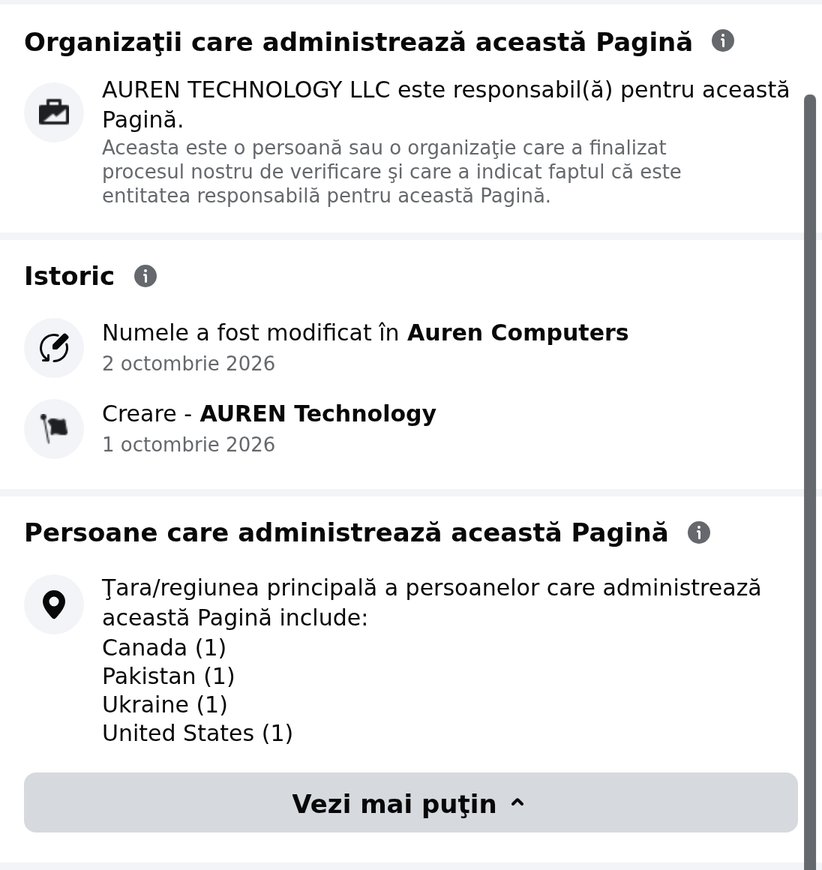
The site names no company and no person. The legal name appears only in Meta’s transparency data: the Facebook page, created on October 1, and the ads are registered to AUREN TECHNOLOGY LLC. The page was created under the name “AUREN Technology” and renamed “Auren Computers” the next day. Meta also shows the primary country of the four people who manage the page: Canada, Pakistan, Ukraine and the United States, one each. Their names are not public.
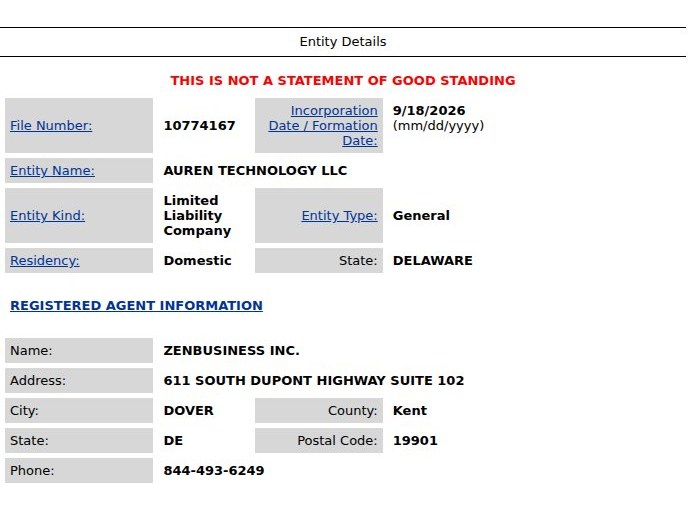
According to the official Delaware business registry, AUREN TECHNOLOGY LLC is a limited liability company formed on September 18, 2026, file number 10774167 (the screenshot is at the end of the article). Its registered agent is ZenBusiness Inc., of Dover, Delaware, a company that forms businesses online and provides them with a legal address. An LLC like this can be set up in a few days for a few hundred dollars, and it is perfectly legal.
The problem is the timeline. The company appears on September 18. The Facebook page and reservations launch on October 1, the domain is bought on October 2, the ads run across Europe from October, and delivery of the first 5,000 units is announced for December 20. From the company’s formation to delivery: 93 days.
In that window, a new computer with its own operating system would have to be designed, tested, mass-produced, certified for sale in the European Union (CE marking is mandatory for computers sold in the EU) and shipped to buyers. On November 23, 27 days before delivery, the company’s cancellation form says the AI models are still being tested and that demos are in preparation. The pieces do not fit.
| Item | What it shows |
|---|---|
| Company | AUREN TECHNOLOGY LLC, Delaware, formed September 18, 2026, file 10774167, agent ZenBusiness Inc. (Dover), according to the Delaware registry |
| Address in the site footer | 600 California Street, San Francisco: an office building where WeWork also offers mailing addresses (virtual office) |
| Contact | the pages list only email addresses (refunds@, privacy@aurencomputers.com); there is no phone number and no “About us” page |
| Domain | registered October 2, 2026, through GoDaddy, with the owner hidden (Domains By Proxy), for one year (expires October 2, 2027) |
| Website | generated with Lovable and hosted by it (the domain’s technical settings point to Lovable’s servers) |
| Payments | Stripe, an account active for real payments; email on Google Workspace; customers synced to Mailchimp |
| Trademark | “AUREN” for AI software (class 9) is registered in the US by Elysian Technologies, Inc., not by Auren Technology LLC |
Taken separately, none of these things is illegal. Taken together, they describe a company assembled in two weeks from rented services: an AI-generated site, AI-generated images, an address in a building with virtual offices, payments and ads bought online. Missing from the public record are the people behind it, premises of its own and any evidence of a physical product.
A product seen only in generated images
Images created with ChatGPT carry a digital provenance label based on the C2PA standard (Content Credentials). The label records who created the file and with what tool, and it is cryptographically signed by OpenAI: any change to the label makes verification fail. It usually disappears if the file is reprocessed by other software: a screenshot, recompression, resizing.
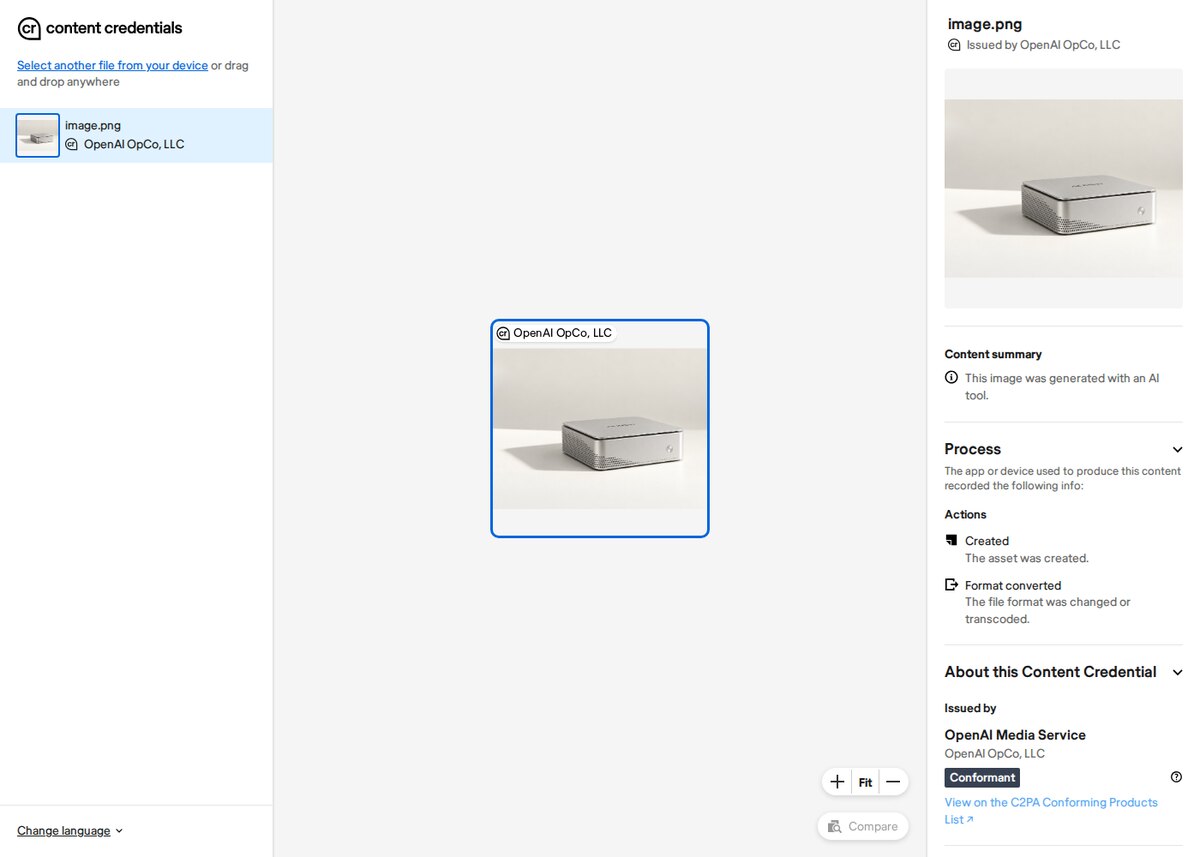
The main product image on aurencomputers.com carries this label. The public verifier contentcredentials.org, maintained by the Content Authenticity Initiative, displays: “This image was generated with an AI tool,” issued by “OpenAI OpCo, LLC.” The file also records the tool (“ChatGPT,” “gpt-image”) and the time of creation.
| File on the site | Created (Romanian time) | With |
|---|---|---|
| auren-one-hero-render.png (main image) | October 2, 2026, 1:12 a.m. | ChatGPT, gpt-image |
| auren-one-desk-dark.png | October 2, 2026, 5:03 a.m. | ChatGPT, gpt-image |
| auren-os-showcase.png (the “Auren OS” interface), archived version | October 13, 2026, 5:10 a.m. | ChatGPT, gpt-image |
| auren-os-showcase.png, version on the site as of November 23 | November 17, 2026, 5:02 p.m. | ChatGPT, gpt-image |
The domain aurencomputers.com was registered on October 2, 2026, at 3:22 a.m. Romanian time (Verisign registry). The product image was therefore generated about two hours before the company bought its web address. The other product images carry no metadata, so their origin cannot be established; all appear to show the same computer-rendered object, from different angles and in different colors. The site has no photographs of a real device, no footage of a prototype and no images of the motherboard.
On Facebook, the same label is out in the open. The page’s first post, “Meet Auren One,” published on October 2 with three colored cubes on a stone pedestal, carries under the page name the label Meta displays on images generated or modified with artificial intelligence (“AI content” in the Romanian-language interface where it was captured; the screenshot is at the end of the article).
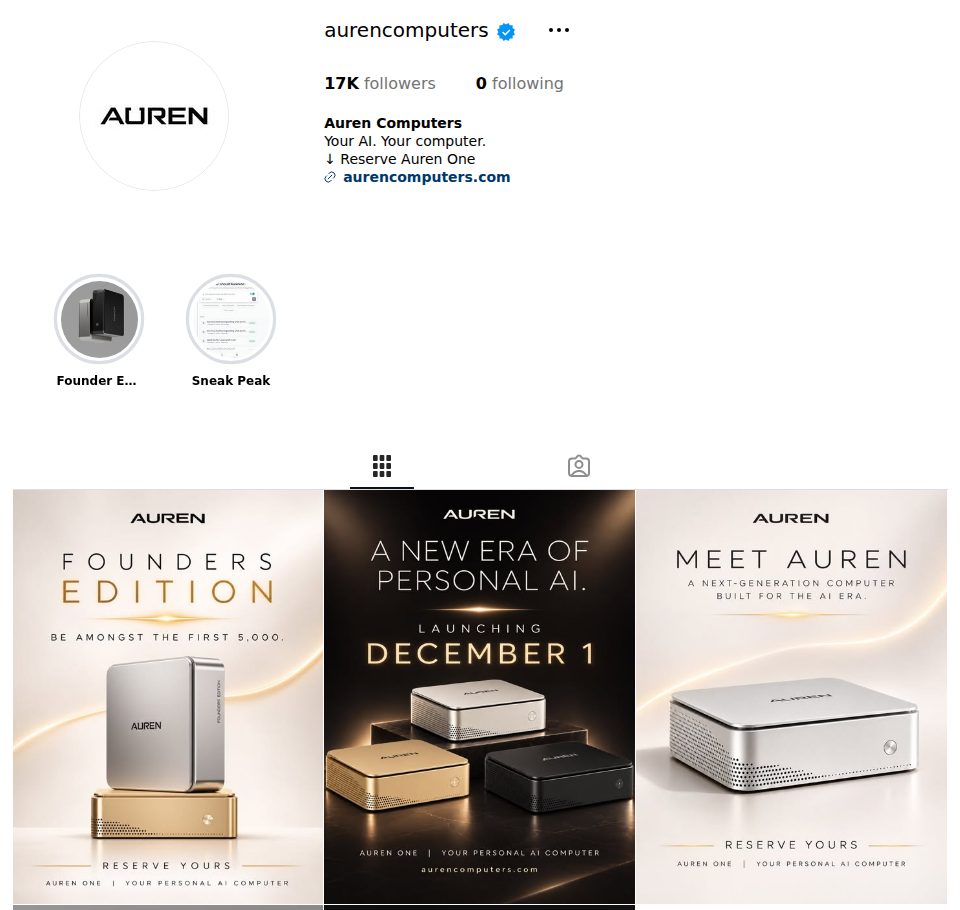
On Instagram, the aurencomputers account has a blue verified badge, about 17,000 followers and follows no one. The visible posts are, again, computer-drawn images of the product in silver, gold and black, with no photo of a real unit. The badge only shows that Meta has verified who owns the account, not that the product exists.
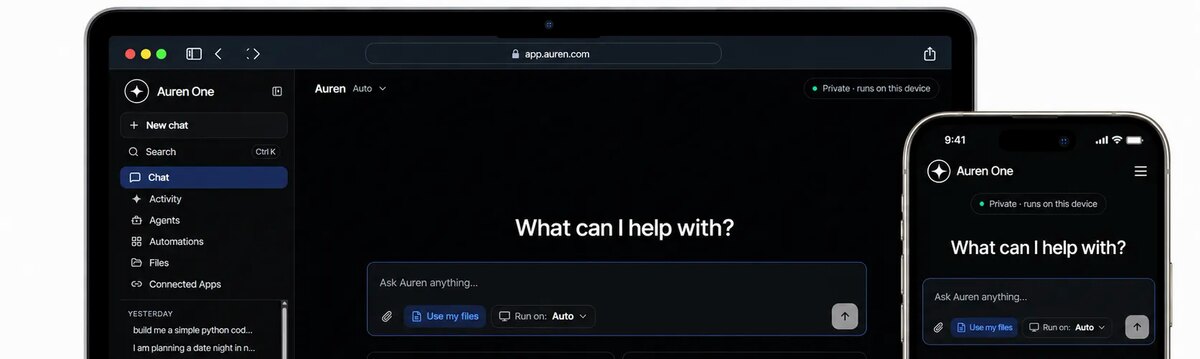
The “Auren OS” interface does not appear in a real screenshot either. The image on the operating system’s page was also generated with ChatGPT, and the address bar of the drawn laptop reads app.auren.com, a subdomain of auren.com, the domain of a Spanish audit and consulting firm with no demonstrated connection to Auren Computers.
The processor that disappeared from the site
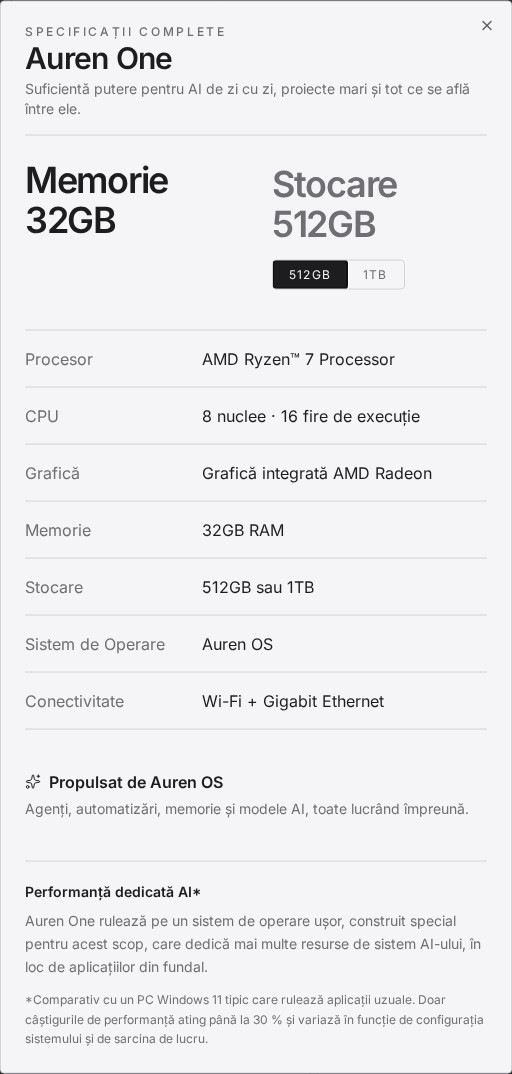
If the images do not show a real device, that leaves the specifications. They, too, have changed since launch. Today, the “Show full specifications” button opens, for the One version, a seven-line list: “AMD Ryzen™ 7 Processor,” 8 cores and 16 threads, “Integrated AMD Radeon Graphics,” “32GB RAM,” 512 GB or 1 TB of storage, Auren OS, Wi-Fi and gigabit Ethernet. Missing are the exact processor model, the memory type and speed, the ports, the power consumption, the dimensions and the weight: precisely the data by which a computer for AI can be judged. The oldest archived version of the site, saved by the Internet Archive on October 2, 2026, was more precise, with a note that pre-launch specifications could change before production.
The 16 GB version had a Ryzen 5 5500U, and the 32 GB version a “Ryzen 5 5700U.” These are processors for thin laptops, unveiled by AMD in January 2021; Notebookcheck notes that the 5500U actually belongs to an older generation than its name suggests. A “Ryzen 5 5700U” does not even exist: the 5700U is a Ryzen 7.
Neither has an NPU, the dedicated circuit that runs AI calculations quickly and at low power; at AMD, it arrived only with the Ryzen 7040 series, in 2023. With the DDR4-3200 RAM these processors support, bandwidth tops out at 51.2 GB/s. The Wi-Fi card on the list, the Intel 8265, was launched in 2016 and has been discontinued.
Today’s specifications keep the same core counts: 6 on the 16 GB version and 8 on the 32 GB version, as with the chips in the archive. The processor’s name is gone, but the description still matches them. The Pro version, with 64 GB, appeared later, also with an 8-core Ryzen 7.
An ordinary computer, not an AI revolution
An AI model is, in practice, a large file, from a few gigabytes to a few dozen. It sits on the SSD, but when it is launched it is loaded entirely into working memory, the RAM, and read from there continuously while it runs. On computers with a dedicated graphics card, the model sits in the card’s memory (VRAM), which is much faster than ordinary RAM. On computers with graphics integrated into the processor, like Auren One, the processor and the graphics share the same RAM.
That explains the three things a computer needs in order to run AI at home. A lot of RAM (or VRAM), because it determines which model fits. Fast memory, because its speed determines how quickly the answer appears. And, ideally, a chip built for this kind of computation, usually a powerful graphics card. The NPU, the AI circuit in newer laptops, helps mostly with small tasks, such as transcription or video effects.
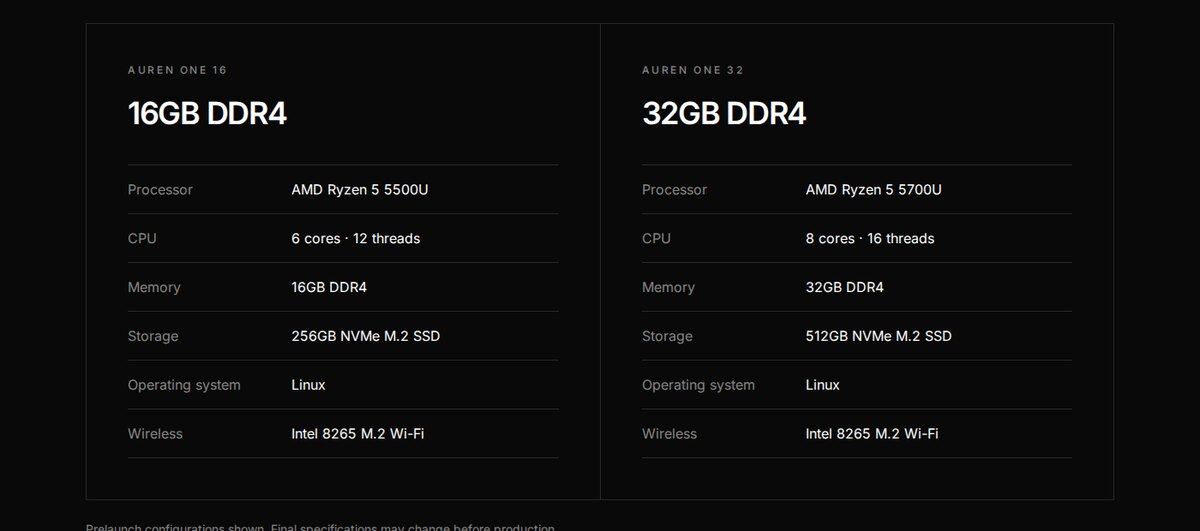
The configuration Auren announced meets only the first condition: it has 16, 32 or 64 GB of RAM. But the RAM listed in the archived specifications is DDR4, roughly five times slower than in devices designed for AI. The processor is a laptop chip, built to draw 15 watts; the graphics are integrated into the processor, so they have no memory of their own; and there is no NPU. It is an office mini PC, in the category of machines used for documents, browsing and movies.
RAM speed matters because of the way an AI model works. For every word it writes, the computer reads almost the entire model from RAM. A 19 GB model, on RAM that transfers at most 51.2 GB per second, can be read at most two or three times per second. That means at most two or three word fragments per second, no matter how much the device costs.
Machines like this have existed for years and are sold without pre-orders. Mini PCs with a Ryzen 7 5700U cost between $330 and $410 in the US, according to comparisons published by Starry Hope. On eMAG, a Romanian online retailer, an ACEMAGIC mini PC with a Ryzen 7 5700U, 32 GB and 512 GB was listed on November 23 at 1,955.95 lei, about 390 euros (out of stock on that date). Auren One with 32 GB and 512 GB costs $999 at the Founder’s Pricing.
What can a computer like this do? It runs small AI models, of 3 to 8 billion parameters, with free programs such as Ollama or LM Studio. A public test on a Ryzen 7 5700U shows 6 to 7 tokens per second for an 8-billion-parameter model: text appears at roughly the pace at which it is read. That is enough for a summary, an email or a simple conversation.
With large models, the ones that approach the quality of paid services, the picture changes. The first archived version of the site promised that 32- and 34-billion-parameter models (“Forge 32B,” “Quill 34B”) run locally on the 32 GB version. A calculation based on the speed of DDR4 RAM gives a theoretical maximum of 2 to 3 tokens per second, and in practice 1 to 2: one word every one or two seconds. The 64 GB Pro version can load even larger models, but it does not make them faster: the RAM is just as slow.
If Auren One uses the processor in the archive or one in the same class, as the core count suggests, everything that runs on it runs just as well on a mini PC with the same processor and the same RAM, bought for less than half the price from an ordinary store, or on a recent laptop with the same amount of RAM. The AI models that run locally are, for the most part, open models that anyone can download for free.
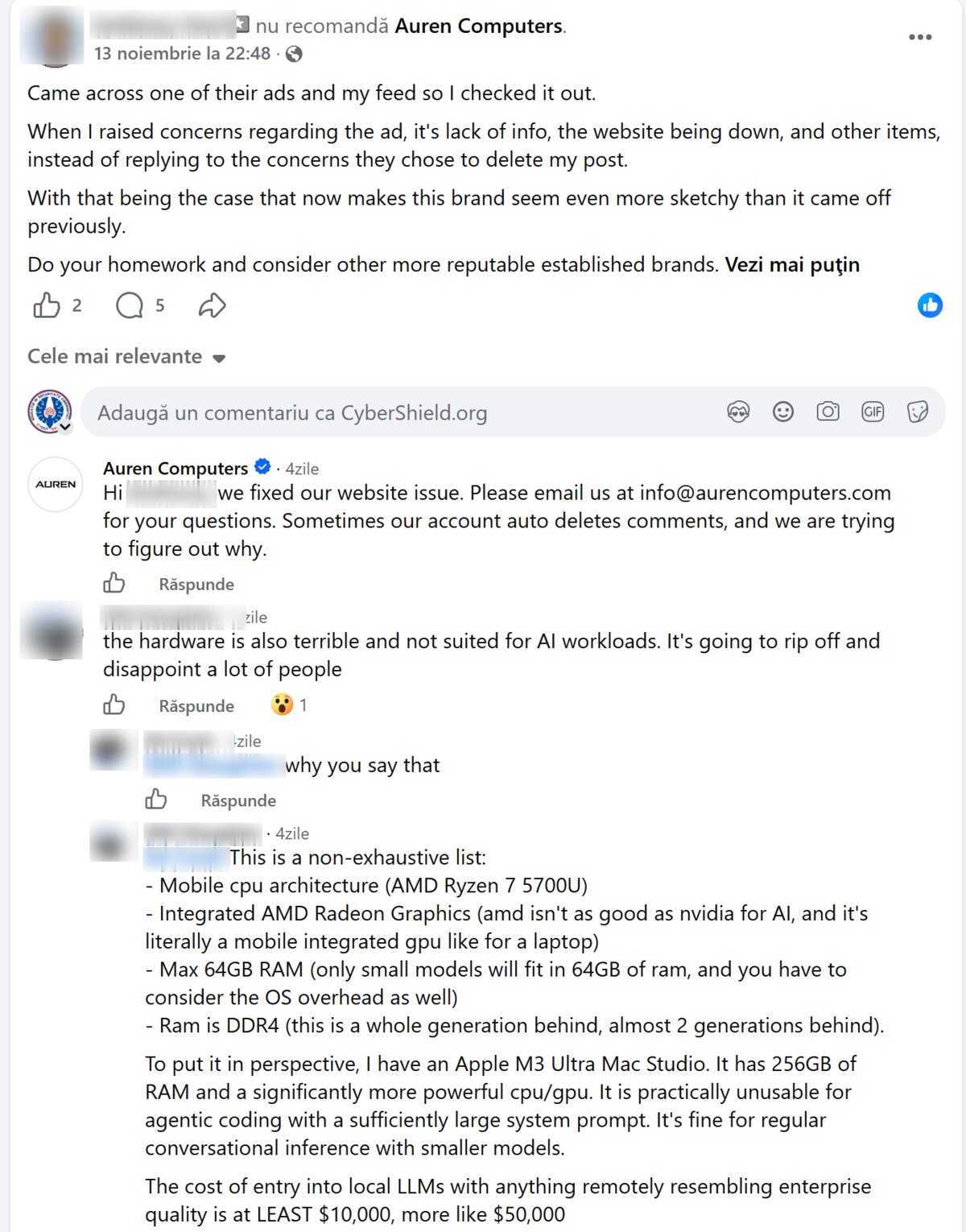
Computers truly built for local AI look different. Mini PCs with the AMD Ryzen AI Max+ 395 have LPDDR5X RAM, shared by the processor and the graphics, at about 256 GB/s, five times faster, and up to 128 GB; such a machine, in the 128 GB configuration, costs around $3,500. On the company’s Facebook page, one user summed up the same point in a single sentence: “the hardware is also terrible and not suited for AI workloads.”
The only performance figure on the site is a footnote. Auren OS, a “lightweight, purpose-built operating system,” would deliver gains of “up to 30%,” “compared with a typical Windows 11 PC running everyday applications.” The site does not say what was measured, how or on what device. The comparison is with a Windows machine loaded with other programs, not with a computer running only the AI model. And for a language model, the bottleneck remains RAM speed: a “lighter” operating system does not make memory faster.
What the site promises, read closely
The site has four pages: the Auren One presentation, the Auren OS page, the privacy policy and the refund policy. All were archived in the Wayback Machine on November 22 and captured in full on November 23. Read end to end, the big promises in the headlines narrow in the fine print below them.
The site’s first sentence says Auren One “is the first computer built purposely for AI.” It is not. Mini PCs with the AMD Ryzen AI Max+ 395, described above, and laptops with NPUs have been on sale for more than a year. And the processor in the site’s archive is a laptop chip unveiled in 2021, before AMD put any AI circuit in its chips.
The second message is the one in the ads: AI with no token fees, with a counter showing “€0.” A note on the Auren OS page, however, specifies that “optional cloud services may cost extra” and that “optional cloud models and third-party services may have separate fees.” Their price is not published anywhere. The difference matters, because the tasks in the presentation are heavy: agents “researching suppliers,” preparing “tomorrow’s report” and working “while you’re away.” Tasks like these require large models, and on this device large models write one word every one or two seconds. That leaves two options: very slow answers, or sending the task to the cloud, for a fee.
The third message is privacy: everyday work “stays on your device.” The privacy policy adds a condition: “When a task needs a higher-level cloud model, only that specific request is sent.” In other words, the request leaves the computer, with everything it contains. The site also promises that Auren OS opens “from your phone or computer” and that actions can be approved “from anywhere.” Remote access usually goes through an intermediary service, and the site does not say who operates it or which servers the data passes through. As for the catalog of “2,000+ integrations,” the same page specifies that “availability varies” and that “apps shown are examples.”
About Auren OS itself, the site publishes no documentation, no test version and no demonstration a visitor could verify. The screens in the presentation are animated graphics; the counter showing “130” “local tasks today” and the agents “comparing sources” appear to be part of the design, not of a working system.
The legal pages are telling as well. Both policies are “Effective November 5, 2026,” although reservations began on October 1, and an earlier version of the refund policy had been archived on October 25. The rules received a new effective date in the middle of the campaign, with deposits already collected. The site promises “a one year limited warranty.” In the European Union, the seller is liable in any case for at least two years for product defects, but a Delaware company with no presence in the EU is hard to hold accountable. And the clause covering the case in which the company cancels the order promises to refund “your deposit in full.” It says nothing about the rest of the price, charged automatically on December 1 to those who opted in to payment.
The privacy policy also shows where payment data ends up. With the visitor’s consent, the site sends the X network “paid deposits (amount and currency),” together with the IP address and the pages visited, to “measure our ads.” Outside the European Economic Area, the United Kingdom and Switzerland, the sharing is on by default, until the visitor opts out.
Finally, the site addresses the entire European Union, in 24 languages, including Romanian. The translation appears to be automatic: the Romanian version contains entire sentences left in English (“Reserving Auren One costs a €20 deposit,” “Built from the ground up for AI”) and untranslated dates. Nowhere does an address or a representative in the EU appear, only the San Francisco address.
A profit calculator that counts deposits as ad money
The site is built with Lovable, an AI web-app generator. Here, the code files the browser downloads on every visit also contain the text of the administration panel. CyberShield did not enter the panel and did not access the database; it read only these public files, archived in the Wayback Machine on November 22 and 23. They show how the company’s panel treats the money from deposits.
From the Auren administration panel code (file admin-CnUF9y_t.js)
Deposits stay refundable until orders open, and recycled deposits have already been spent, so raise the deposit refund rate if you expect non-buyers to ask for theirs back.Deposit cash left after refunds and card fees is put back into adsNon-buyers' unrefunded deposits are keptStop or revise if costs rise, actual spend falls short or the test exceeds what you can afford to lose.The same code contains a profit calculator with default values: 100% of deposits reinvested in ads, an average selling price of $449 and a manufacturing cost of $55 per unit (the site’s settings file). The values can be overwritten with real figures, so $55 is not necessarily the current cost. But the starting calculation describes a product sold for hundreds of dollars, with a manufacturing cost of a few dozen dollars, financed by customers’ deposits. The same section of the code recommends increasing the ad budget in three-day steps, recalculating after each step.
If the company applies the calculator’s model, refunds have to be paid from other money, because the deposits have already been spent on ads. The public data does not show whether the model was applied. The code also contains “Deposits from the earlier Stripe account must be refunded there first”: some of the deposits were collected through a Stripe account that preceded the one in use now.
“No questions asked,” with a form attached
The refund page says: “fully refundable at any time […] No conditions, no restocking fee and no questions asked.” The panel’s code describes a longer path.
Every email about cancellation is first read by an AI (“Every email that mentions cancelling or a refund is first read by AI”), which separates such emails from “Questions (not cancelling)”; the team can correct the classification manually. The standard reply to a cancellation request is a link to a form (“press Send form to reply in the thread with the form link”), and the bulk refund includes only those who filled it out and chose cancellation (“Only buyers who filled the form and chose to continue with the refund are included”).
The panel also has a “Refund everyone who asked more than once” button, for those who have asked for their money at least twice and are still waiting. And if a customer resubmits the form and chooses to keep the reservation, only the last answer counts and the customer is no longer refunded (“[…] only the newest answer counts, so a buyer who chose ‘Keep my reservation’ afterwards is not refunded”).
The form asks for the reason (options include “I wasn’t expecting the automatic balance payment”), then tries to keep the customer. Its answers show the product’s stage of development, eight days before the charge and 27 days before delivery:
From the Auren cancellation form (Typeform “Auren Reservation Support”)
Our software team is testing and selecting local AI models for each configuration, with model details and benchmarks coming soon.We're preparing demos showing Auren in action [...] Independent reviews are separate, and we don't have a confirmed date for those.Anyone who declines automatic payment is warned that “it may delay your order,” because the company prioritizes customers who choose their configuration earlier.
The refund policy also says that only “approved” refunds are processed (“We process approved refunds”) and is dated “Effective November 5, 2026,” although the reservation period began, according to the same page, on October 1. The site’s translation strings preserve an earlier version, dated October 25, which set the refund deadline at November 1; the deadline was later moved to December 1.
Unanswered questions
A complaint about deleted comments also appeared on the company’s Facebook page. On November 13, a user left a negative review on Auren’s Facebook page, writing that they had asked questions about the ad, the lack of information and the site being down, and that the company, instead of answering, deleted the post. Auren’s reply came under the review: “Sometimes our account auto deletes comments, and we are trying to figure out why.”
CyberShield sent questions about all of these findings to Auren Computers / AUREN TECHNOLOGY LLC, at the email addresses published on the site. As of publication, CyberShield had received no response from Auren Computers / AUREN TECHNOLOGY LLC. This article will be updated if a response arrives.
93 days, in brief
The company is formed, with ZenBusiness as its agent (Delaware registry).
The page is created as “AUREN Technology” and renamed the next day; the reservation period begins, according to the site.
The main image is generated with ChatGPT, two hours before the domain is bought.
aurencomputers.com is registered; the archive from the same day shows a Ryzen 5 5500U, DDR4 and “Shipment begins in December.”
The oldest ads visible in the Ad Library; the panel code counts Meta spending from as early as October 1.
The current version (the second known one, after the one from October 25).
The AI models are still being tested, and the demos are still in preparation.
At 5:00 p.m. Romanian time (EET), the balance is taken from the saved cards.
“It ships from December 20.” Ninety-three days after the company was formed.
Too many red flags
Taken one at a time, some of these findings have possible explanations. Put together, they form a list that is hard to ignore:
The red flags and unanswered questions are too many for Auren One to convince anyone that it is a product that does what it says. CyberShield’s advice is to treat pre-orders like this one with maximum caution.
All the more so because the central promise, powerful AI at home, does not match the announced configuration. With a 32-billion-parameter model, like those promised on the first version of the site, a one-page email would take 4 to 8 minutes to write, word by word; an online service writes it in seconds. And before the first word, the model has to read all of the text it was given: to summarize a 20-page document, that step alone could take, by CyberShield’s estimate, ten minutes or more. The only models that run fast on this device are small ones, far weaker than the services the ads compare it to.
If Auren One never arrives
Delivery is promised from December 20. For anyone who has paid and is waiting for the device, a few things are worth doing early:
If Auren One arrives but does not do what the ads promised
The second scenario: the device arrives, but turns out to be an ordinary mini PC that runs only small, weak models, and the large ones extremely slowly.
Local AI without an “AI computer”
Ollama and LM Studio, both free programs, run AI models on ordinary computers. For large models, machines actually built for the purpose are sold by companies with names, addresses and independent reviews.
The rule is the same as for any pre-order: before paying a deposit, look for the names of the people behind the product, how long the company has existed, a photo or video of the real prototype and at least one independent review.
Frequently asked questions
Is Auren One a scam?
Delivery is promised for December 20, so non-delivery cannot be established yet. Several things can be verified, however: the company was formed on September 18, 2026; the main image and two other images on the site were generated with ChatGPT; the processor originally advertised is a 2021 laptop chip; the administration panel code includes a profit calculator that assumes all deposits are reinvested in ads (public data does not show how much is actually spent); and the “no questions asked” refund goes through a retention form. CyberShield’s conclusion: the red flags and unanswered questions are too many for the product to be convincing, and pre-orders like this one should be treated with maximum caution.
How can I check whether an image was generated with AI?
Upload the original file to contentcredentials.org/verify. If it has a C2PA signature, you can see who issued it and what tool was used to create the image. The absence of a signature does not prove the image is real: the signature disappears on conversion or in a screenshot.
How can I find out how old a US company is?
US states keep public business registries; for Delaware, the official registry is kept by the Secretary of State, and aggregators such as Bizapedia republish that data. A company formed a few weeks before its first sales campaign is a reason for caution.
Can I lose more than $20?
Yes. If you chose a model and accepted automatic payment, on December 1 the rest of the price is charged to your card, between 679 and 1,579 per unit, in dollars or euros, depending on the currency of the reservation.
What do I do if Auren One never arrives?
Keep the receipt, the emails and screenshots of the offer. After December 20, ask in writing for the delivery date and set a final deadline. If the device still does not arrive, ask your bank to dispute the payment (a chargeback) for goods not received while you are still within the deadline, and file a complaint with your consumer authority and on econsumer.gov.
What do I do if the device does not do what the ads promised?
Test it and film the test in the first days. You have 14 days from delivery to withdraw without giving a reason, announced in writing; after that, a product that does not match its description is covered by the two-year legal guarantee. Until it is clear what data it sends to the cloud, do not connect personal or work accounts to it.